
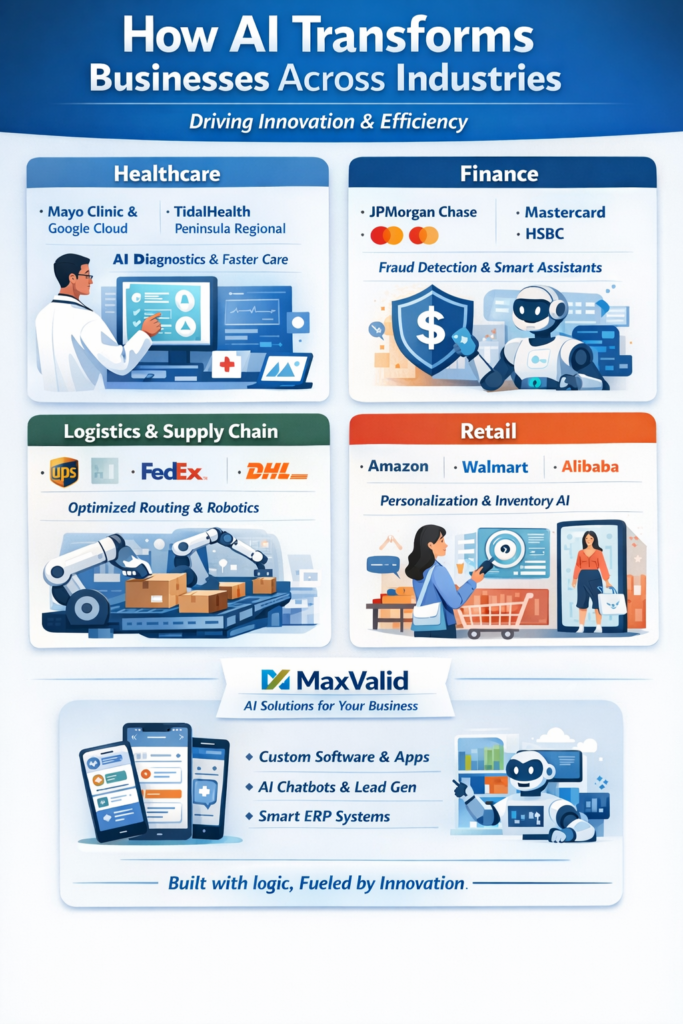
Healthcare
TidalHealth Peninsula Regional (Atlantic Health) – Implemented IBM Micromedex with Watson (AI/NLP) in its electronic health records. The AI scans patient charts and literature to prioritize critical information for clinicians. As a result, clinicians’ average search time dropped from about 3–4 minutes to under 1 minute per query, freeing time for patient care and speeding clinical decision-making.
Mayo Clinic (with Google Cloud) – Partnered with Google Cloud to build an AI/ML platform for patient care and research. This system uses machine learning on medical data (e.g. imaging, EHRs) to automate complex analyses. For example, tasks like calculating disease progression trends or assessing breast cancer risk from historical data are now automated. Embedding AI into workflows has allowed faster data-driven insights and more personalized care.
Valley Medical Center (WA) – Deployed Xsolis Dragonfly (AI-driven case prioritization) in its radiology and care-review process. The AI automated the scoring and routing of clinical cases to specialists. Within months, Valley Medical went from completing 60% of required case reviews to 100% – a 67% improvement in review rate. This efficiency gain reduced delays and improved quality of care.
Finance
JPMorgan Chase – Uses AI-powered graph analytics for fraud detection. JPMorgan implemented TigerGraph’s high-speed graph database with integrated ML to identify complex fraud patterns in real time. This system processes 30+ TB/day of transactions with sub-80ms response, unearthing synthetic fraud networks. The outcome was $50 million in annual savings from fraud prevention while protecting 60 million households.
Mastercard – Enhanced fraud-detection with Generative AI and machine learning. Mastercard’s “Decision Intelligence” system continuously scores 160+ billion transactions/year. Recent generative AI models have doubled the detection rate of compromised cards and reduced false positives by up to 200%. Banks now receive alerts faster and more accurately, enabling immediate card-blocking when needed, which boosts security and customer trust.
HSBC – Embarked on a wide-ranging AI adoption across banking operations. The bank reports 600+ AI use cases in fraud, cybersecurity, customer service, etc. For example, HSBC deployed LLM-based coding assistants to 20,000 developers, cutting development time by ~15%. A generative-AI customer-service assistant handles 3 million annual client interactions, reducing turnaround time, with 88% of clients rating the experience “easy”. These AI tools streamline processes (like credit analysis, call summaries) and improve service at scale.
Logistics and Supply Chain
UPS (United Parcel Service) – Uses the ORION route-optimization system (AI-driven routing). ORION computes 200,000+ route options per driver per day, considering traffic, package details, etc. By 2024, it reduced each driver’s route by an average 2–4 miles, saving 100 million miles per year and roughly $300 million in operating costs. To date, UPS’s $250M ORION investment returned $320M in savings by 2015, projected $400M/year by 2025, and cut fuel use by ~10 million gallons annually. During peak seasons, ORION let UPS handle a 15% volume surge without adding vehicles, reducing driver idle time by ~20% and improving delivery times.
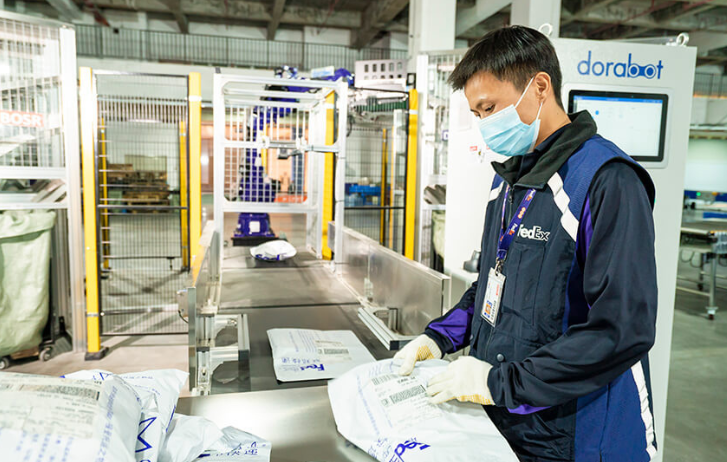
Image: FedEx AI-powered sorting robots in an Asia-Pacific logistics center, enabling faster, more accurate package routingFigure: FedEx’s use of AI robotics for automated sorting (Singapore facility) can handle 1,000 packages/hour across ~100 destinations.
FedEx – Deploying AI-powered robotics in sorting and last-mile. In Asia-Pacific hubs, robotic arms with AI vision now pre-sort packages: e.g., a FedEx Singapore facility’s robot scans barcodes and routes ~1,000 packages/hour to ~100 destinations simultaneously. This automation cuts manual sorting errors, improves throughput in peak periods, and accelerates shipping. FedEx is also testing AI robots for truck loading (Dexterity.ai’s two-armed robots) and autonomous delivery (QuikBot indoor robots) to free human workers from repetitive tasks.
DHL Supply Chain – Piloted agentic AI “digital workers” (via startup HappyRobot) to automate communications. AI voice/email agents autonomously handle routine tasks like appointment scheduling, delivery status calls, and warehouse coordination. These agents process hundreds of thousands of emails and millions of call-minutes annually. The result is faster, more consistent communication with customers and drivers, a reduction in manual workload, and teams freed to focus on strategic or exception cases. Employee satisfaction rose as repetitive tasks were offloaded to AI, improving overall operational responsiveness.
Retail
Amazon – Leveraged AI for logistics and personalization. Delivery accuracy: Amazon’s new generative-AI mapping (Wellspring) ingests satellite imagery and historic delivery data to pinpoint apartment entries, mail rooms and parking spots. By Oct 2024 it had mapped ~2.8 million apartment addresses to buildings and 4 million addresses with optimal drop-off points. This helps drivers reach customers’ actual doorsteps. Inventory forecasting: A foundational ML model predicts product demand (factoring in weather, events, etc.), improving long-term deal-event forecasts by ~10% and regional forecasts by ~20%. Better forecasts mean placing the right products in the right warehouses, enabling faster same-day delivery options and reducing out-of-stock situations.
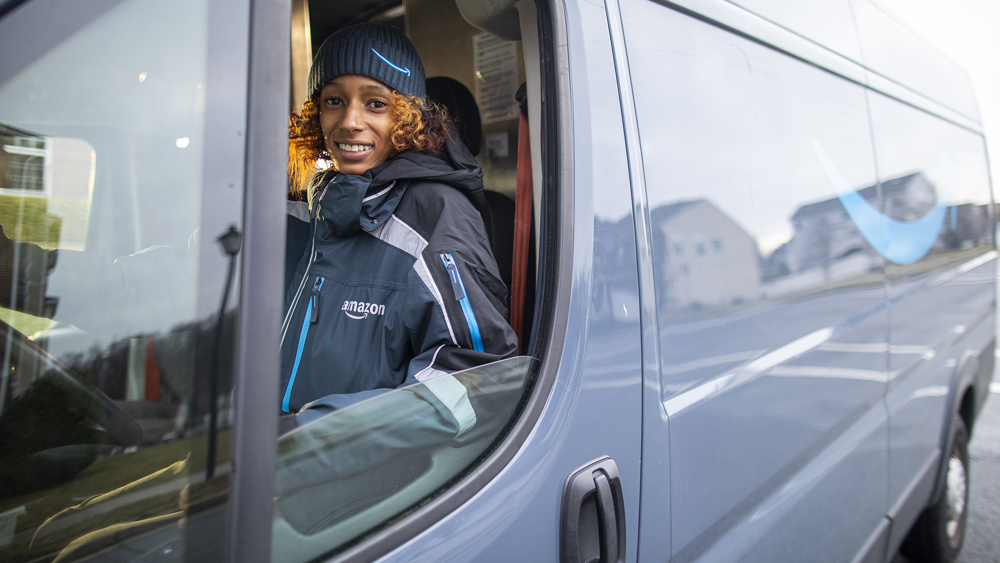
AI-driven sorting and routing in Amazon’s fulfillment operations. Amazon’s AI innovations in mapping and forecasting enable faster deliveries and smarter inventory placement.
Walmart – Rolling out AI tools for store operations and workforce. For example, an AI-driven task-management assistant (via its “Associate App”) prioritizes stocking tasks. Early results show store leads cut shift-planning time from 90 minutes down to 30 minutes. Walmart also deployed a real-time translation tool (44 languages) for associates, and upgraded its voice assistant with generative AI to answer complex questions. These tools improve store efficiency and employee productivity. Underlying all this is Walmart’s “Element” ML platform, which powers these AI features at scale.
Alibaba (Taobao/Tmall) – Uses AI/ML via Alibaba Cloud to enhance e-commerce. During the 11.11 shopping festival, Taobao/Tmall tapped the Tongyi Qianwen LLM for chatbots and tools. The Ali Xiaomi chatbot (LLM-powered) answered user queries more accurately and interactively (asking clarifying questions). Tens of thousands of merchants used Alibaba’s generative tools to write marketing copy and promotions. A new virtual try-on feature (deep-learning AR) let 500,000+ users virtually fit clothes from 3,500+ stores. On the supply side, an AI “Energy Expert” model enabled brands to calculate product carbon footprints, driving more sustainable practices. Overall, Alibaba’s AI solutions delivered richer personalization, faster service, and more efficient merchant operations.
Manufacturing
Toyota – Built an AI platform for factory workers (on Google Cloud). Instead of centralizing AI development, Toyota gave line workers easy AI tools (web apps, edge devices) to automate their tasks (inspection, anomaly detection, etc.). By 2024, employees created 10,000 custom AI models and Toyota reported saving ~10,000 man-hours per year through these grassroots AI solutions. This democratized approach accelerated AI deployment: engineers could rapidly solve local problems without IT bottlenecks. Toyota used these models for quality inspection, predictive maintenance, and worker safety (AI edge-cameras in 500 locations). Empowering workers with AI not only boosted efficiency but also fostered innovation on the shop floor.
Tesla (Gigafactories) – Adopted AI-driven predictive maintenance on assembly lines and machinery. By continuously monitoring equipment sensors and machine health, Tesla’s systems predicted failures before they halted production. In 2025, Tesla cut unplanned downtime by over 30% at its Fremont plant. This increase in uptime raised output without adding equipment and drove down costs per unit (fewer overtime and repair delays).
BMW (Regensburg plant) – Similarly implemented AI for maintenance. BMW’s predictive systems reduced assembly-line holdups by 500+ minutes per year. Across the automotive line, such AI maintenance programs have lowered maintenance spend by ~20–25% and boosted equipment availability by ~15–20%, enabling more consistent production and faster new-model ramps.
MaxValid Software Solutions
MaxValid is a Bangladesh-based tech startup offering end-to-end AI-powered software development and consulting. It provides services like UI/UX design, mobile and web app development, SaaS platforms, and custom AI/ML solutions. Its offerings include chatbots, intelligent lead-gen calling systems, real-time inventory/ERP platforms, and other data-driven tools.
- Services: Custom software and app development (iOS/Android/web), UI/UX design, and AI integration. For example, MaxValid’s portfolio shows an AI-powered automated calling/lead-gen system and a smart inventory-management ERP system.
- AI Focus: Specializes in AI/ML integration and chatbot solutions. A Clutch profile highlights that MaxValid “specializes in AI-powered app development, AI chatbot solutions, machine learning integration, and intuitive UI/UX design,” helping businesses create more engaging, intelligent software experiences.
- Value Proposition: MaxValid emphasizes human-centered design and strategic automation. Its tagline is “built with logic, fueled by innovation” – delivering “intelligent, scalable, strategy-driven digital solutions” that help clients streamline operations and unlock growth. In practice, this means they craft AI-driven tools (e.g. intelligent call agents, smart data dashboards) tailored to each customer’s workflow, ensuring long-term efficiency and competitive advantage.
Sources: Our industry examples and data are drawn from recent case studies and press releases in each sector. These demonstrate how AI technologies (from machine learning and robotics to generative models and digital twins) are reshaping operations and policies across industries.